Jishka Which of the Following Statements Csn Be Used as Evidence Thst Ancient Greek Beliefs and Art
Here we look at how the influences on Aboriginal Greek art, including the importance, and what is meant past, the Goldern Ratio.
Art developed so much during the Aboriginal Greek Flow that it became the driving influence on fine art for the following centuries.
What influenced Aboriginal Greek art?
Ancient Greek art was influenced by the philosophy of the fourth dimension and that shaped the fashion they produced art forms. The difficulty in understanding Ancient Greek art is that the philosophers held a theoretical view of colour and art while the artists were more pragmatic in their production of art. This might be because the Aboriginal Greeks did not take a concept of fine art. They used the give-and-take techne, which translates equally 'skill', to describe painting or any skilful act. Artists and architects were artisans.
Here in the give-and-take techne we run across the embryo of what was to get technology. Then, for the Ancient Greeks, art and engineering science were closely entwined, and it could be argued that this was influenced by the theories of Plato and Aristotle.
Did Plato and Aristotle hold in their views?
Plato's (c429-347 BCE) view of the earth was as something always changing − a poor, decaying copy of a perfect, rational, eternal, and invariable original. Then the beauty of a bloom or a sunset is an imperfect copy of 'beauty' and but a pointer to perfection.
In book The Republic, Plato says art imitates the objects and events of ordinary life. It is a re-create of a copy of perfection, and so even more of an illusion than ordinary experience. Works of art are at best entertainment, and at worst a unsafe delusion. Fine art is imitation, which was known as mimesis (the representation of nature). Nosotros tin can conclude that Plato didn't take the notion of 'fine art beingness created past divine inspiration' very seriously.
Aristotle (384-322 BCE) on the other hand, saw an 'art' grade as a style of representing the inner significance of something, the 'essence'. To Aristotle art offers unity and the form should be consummate in itself. He sums this up in his theory of mimesis; the perfection and imitation of nature. And then, now art as imitation involves the use of mathematical ideas such as symmetry, proportion and perspective in the search for the perfect, the timeless and contrasting object.
Hence the Greek concept of beauty was based on a pleasing balance and proportion of form. The Ancient Greeks were innovators in the field of art and developed many new styles and techniques to achieve that perfectness of residue and proportion and that concept has influenced countless artists ever since. Information technology tin be argued that fine art upward to the Greeks had been abstract and formal, while from the Greeks onwards it was based upon realism.
The idea of imitation to create realism through the capture of the essence of a class was all the same very strong in the Renaissance, when Vasari, in his Lives of the Painters, said that:
"… painting is just the imitation of all the living things of nature with their colours and designs but every bit they are in nature."
Dazzler and utility
The ancient Greeks were obsessed with aesthetics (from the Greek aisthetikos, significant 'of sense perception'). Aesthetics is the written report of beauty and the Ancient Greeks held dazzler above all. To Plato it was an ideal.
Despite the differences in Plato's and Aristotle'south views of art they did agree that art objects should effort to be beautiful and useful. For Plato beauty was summed upwardly in an object'southward suitability and utility for purpose. It is from these times that beauty is linked to function.
Aristotle wrote about the idea of four causes. The first formal crusade is like a blueprint for the idea. The 2d cause is the material; what a thing is made out of. The third cause is the procedure by which the artist makes the thing. The fourth cause is the purpose of a thing, known as telos.
Aristotle considered information technology important that at that place be a certain distance betwixt the work of fine art on the ane hand and life on the other. Functionality in these terms leaves the states with a dilemma.
Can't an object be beautiful without being useful?
It is possible to see the problem since the skills of the artist, the craftsman, and the technologist involve changes. A sculptor changes a block of marble into a statue, the artist changes pigments into a coloured motion picture, and the craftsman uses tools and heat to change a cake of metal into a tool. Only really two of these examples would be described as art and the other as applied science.
It appears that art and technology accept diverged completely. Information technology could be rationalised as artists aspiring to requite permanence to the present, by creating works that will suffer for all time, and technicians aiming to employ skills to printing on into the future, to new discoveries which will alter with time. So, technology is about permanent change, comeback and moving society on to a new age; progress.
False or self-expression?
The concept of realism and beauty could yet be the most unremarkably held theory for fine art amongst the majority of people today. But is that too simplistic?
John Ruskin writing about art (1819-1900) stated:
"Art does not represent things falsely, but truly as they appear to mankind."
Nevertheless non long afterwards, Pablo Picasso (1881- 1873), when asked whether he painted what he saw, replied:
"I paint what I know is there."
Painting what i sees is a description of art as imitation, but Picasso's is clouding the outcome of imitation alluding to artistic creation as something entirely inside the creative person. So at present the goal of the creative person is self-expression, not necessarily fake of any characteristic. Inspiration and the subject affair can derive from within the mind of the artist, or they could be trying to distil the essence of what is seen, creating an brainchild of its qualities.
Arguably this view of art as an expression started with the impressionists in France, and their attempts to capture art through calorie-free. The artist is not but painting a representation, simply giving a personal impression of what is seen. A painting or a slice of sculpture no longer has to refer to something familiar. It can consist of abstract lines, shapes and colours expressing the inner thoughts, imagination or emotions of the creative person, or pure abstraction itself.
In that location is still a whisper of the Greek platonic since harmony is found in symmetry. An prototype which is perfectly balanced is appealing, and the perception of color as contrasts tin be beautiful in its rest.
Another dilemma - What is colour?
Aristotle believed light is something transmitted from an object to the eye, so the colour of the object is an intrinsic holding, like its weight or taste.
Aristotle reasoned that in a rainbow each droplet of water acts like a tiny mirror. They reflect light and such mirrors change white light into coloured calorie-free. This lead to the idea that colour in a rainbow is not the same as normal colour. Aristotle knew about prisms and the way low-cal is refracted into its colours but he once again believed the glass was modifying the light.
Isaac Newton, in the 17th century, also showed that white light was split up into the spectrum of red, orange, xanthous, green, bluish, indigo and violet. When he used a lens to re-focus the spectrum the issue was white light, showing that low-cal is made upward of dissimilar wavelengths and is not modified past passing through a prism.
The Greeks also held a view that color was related to low-cal and dark, and so yellow would be related to light, and blue to dark. They also spent fourth dimension trying to link pigment colours to the four Aristotelian elements, which pb to the notion that mixed colours are junior to the pure colours. This could be seen as the origin of primary and secondary colours, since mixing colours changes the tone and hue and sometimes moves towards a brown or dark color.
In today's globe we refer to ii types of main colours. The commencement concerns the colours of projected calorie-free known as additive primary colours, which are ruby-red, greenish and bluish. In the world of painting the primaries are reflected light, known as subtractive primaries, and are cyan, magenta and yellow, though an artist will refer to them as blue-light-green, violet-ruby and yellow.
In Aboriginal Greece, mimesis was the idea that influenced the creation of art every bit a model for beauty.
Examples of where the theories of Greek art have been used
The 2d half of the 5th century BCE, the Golden Age of Greece was the menstruation of the nigh beautiful art and compages. To wait at the way this symbolises the Greek ideas of art we must consider the role geometry plays in the story. Geometry was inbound a series of great developments i of which was the Gilt Mean or Ratio.
Phidias and other architects knew, and used, the principles of geometry and eyes. Their mantra was: 'Success in fine art is achieved by meticulous accuracy in a multitude of mathematical proportions'.
Their buildings symbolised perfection through the dazzler of calculated geometric harmony. In the metropolis of Athens geometry took another course. Philosophers were lecturing on mathematics, geography and rhetoric. Their method was called dialectics, and had been borrowed from the geometers in the design of deductive reasoning and proofs.
Pythagoras (560-480 BCE), the Greek geometer, had founded a school of philosophy in Athens where mathematics was studied and taught. Pythagoras was peculiarly interested the proportions of the human figure and had shown, in the Golden ratio, that it was the basis for the proportions of the man effigy. Pythagoras' discovery had a huge effect on Greek art. In architecture every part of a major building was synthetic upon this proportion and the Parthenon was perhaps the best case of a mathematical approach to art.
It is true the Parthenon (447-438 BCE) had been designed by Ictinus (c450-420 BCE) and Callicrates (5th century BCE) according to mathematical principles but there is no prove of the use of the golden ratio. Its surrounding pillars were an case of applied 'number': an even 8 pillars in the front, as Pythagoras advised, so that no fundamental column would block the view, and so where information technology was alright to take an odd number, 17 pillars were built on each side.
Some people accept gone further and claimed the Parthenon was built according to the principles of the Gold Ratio. Notwithstanding as stated, in that location is no stiff evidence to support this. Analysis has shown that parts do follow the principles, only there are many who take demonstrated that when a beautiful piece of art is analysed the proportions will all follow the Golden Ratio. The question is: Is that by design or just the eye of inspiration?
It was not until 300 BCE that knowledge of the Gold Ratio was published and this was in an historical record by Euclid called 'Elements'. And so, maybe it was the influence of Pythagoras on mathematicians at the time that promotes this idea. In his record Euclid had shown that in the Gilded Ratio (known as phi Φ) the longer part of a line divided by the smaller part of the same line is equal to the whole length divided past the longer function. This ratio (phi Φ) is one.6180339887. See the diagram below:
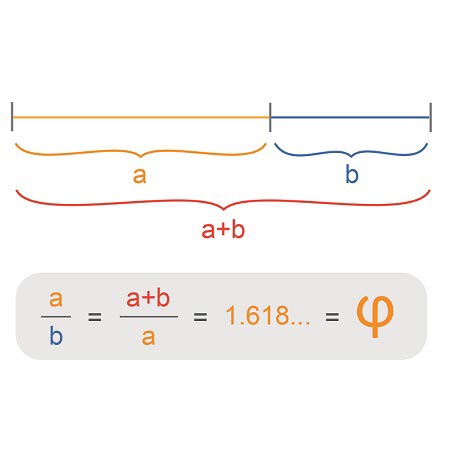
If the Aureate Ratio was applied by an artist it produced a remainder and harmony in the object. Whether or not the ratio was practical in the structure of the Parthenon, to the Greeks it was considered the almost pleasing building to the eye.
The Greek sculptor Phidias sculptured many things using the Golden Ratio. Many artists who lived after Phidias, such as Leonardo Da Vinci (1452-1519), used the ratio in the execution of their work. Indeed the Mona Lisa has been shown to arrange to the Gold Ratio.
Perspective
Some other important development in fine art is that of perspective; the illusion of three dimensions (3D) from a two-dimensional (2D) picture. In it the artist must apply tricks to fool the observer's sight into perceiving the object in 3D.
Every bit part of the Ancient Greek theatre the Greeks had experimented with perspective from the 5th century. To give the scenery depth they created illusions using skenographia in which depth of colour and foreshortening created the sense of depth. However, in terms of linear geometry the Aboriginal Greeks did not have a clear idea of perspective. The philosophers Anaxagoras (c500-428 BCE) and Democritus (c460-370 BCE) worked out some uncomplicated geometric theories of perspective for utilize with skenographia on the stage, but in art information technology was not and then widespread other than in the use of color, tone and hue.
To conclude, Ancient Greek art was influenced past the philosophy of the day and there are arguments to back up the proposal that to the Greeks, good art was virtually faux, with residue, proportion and harmony in colour and construction, to create beauty.
Source: https://edu.rsc.org/resources/greek-art-theory-influences-future-art/1638.article
0 Response to "Jishka Which of the Following Statements Csn Be Used as Evidence Thst Ancient Greek Beliefs and Art"
Post a Comment